![favicon_GI.png]](https://knowledge.gantner-instruments.com/hs-fs/hubfs/favicon_GI.png?width=40&height=40&name=favicon_GI.png)
How Does a Thermocouple Measure Temperature?
A thermocouple measures temperature using the Seebeck effect. Two dissimilar metals joined at a measuring junction generate a small thermoelectric voltage proportional to the temperature difference between the measuring and reference junctions. Standard types, including Type K, provide predictable outputs. Thermocouples are self-powered, require no excitation current and need cold-junction compensation for accurate measurement.
What Is Cold-Junction Compensation and Why Is It Required?
Cold junction compensation (CJC) corrects for the reference junctions formed where thermocouple wires connect to a measuring instrument. A precision thermistor or temperature sensor measures the temperature at the input terminals. The instrument combines this measurement with the thermocouple voltage and standardised reference tables to accurately calculate the true temperature at the thermocouple’s measuring junction.
Q.series A104 Thermocouple DAQ Module: Specifications and Capabilities
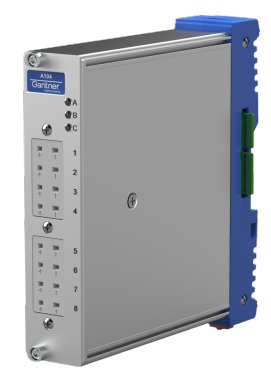
The Q.series A104 and Q.series X A104 are Gantner Instruments’ high-performance thermocouple input modules for precise temperature measurement. Their key technical specifications include:
-
8 input channels, each with a sampling rate of up to 100 S/s
-
Supports Type B, E, J, K, L, N, R, S, T and U thermocouples
-
Measurement accuracy: ±10 µV
-
Resolution: 10 nV
-
Integrated 50/60 Hz mains-frequency rejection filter at 6 or 10 S/s
-
Sensor fault detection for broken wires, loose connections and thermocouple burnout
-
Channel-to-channel isolation: 100 VDC
What Factors Affect Thermocouple Measurement Accuracy?
Thermocouples provide reliable temperature measurements, but the overall measurement accuracy depends on the complete signal chain. The total measurement uncertainty comprises several contributing factors:
-
Thermocouple tolerance, inhomogeneity, ageing and drift.
-
Errors introduced by thermocouple extension or compensating cables.
-
Cold-junction compensation uncertainty.
-
Errors associated with thermocouple characteristic linearisation.
-
Measurement amplifier accuracy, including offset, gain error and drift.
Thermocouple Error Sources and How to Reduce Measurement Uncertainty
Thermocouple Sensor Tolerance, Inhomogeneity and Drift
Minor variations in alloy composition during manufacture can affect the Seebeck coefficient, resulting in unavoidable sensor-to-sensor deviations. Thermocouple accuracy is therefore specified as a tolerance rather than an absolute value. Depending on the thermocouple type, tolerance class and temperature range, standard thermocouples typically achieve measurement deviations of approximately 1% or better at the measuring junction.
Thermocouple Extension-Wire and Cable Errors
Fine thermocouple wires minimise thermal shunting and provide a rapid response to temperature changes. However, their relatively high electrical resistance can introduce measurement errors if the input impedance of the measuring instrument is insufficient. For example, a thermocouple conductor with a diameter of approximately 0.25 mm (about 30 AWG) may have a resistance of around 15 Ω/m, depending on the alloy.
For long cable runs, keep the fine thermocouple leads as short as practicable and use the correct thermocouple extension or compensating cable, with larger conductors and lower resistance, between the sensor and the measuring instrument. The cable must be compatible with the thermocouple type and connected with the correct polarity.
Thermocouple errors can increase over time due to oxidation, contamination, metallurgical changes or exposure beyond the specified temperature range. These effects alter the thermoelectric properties of the conductors, causing inhomogeneity, drift and increased measurement uncertainty.
Cold-Junction Compensation Error
Cold-junction compensation corrects for the reference-junction temperature at the measuring instrument, which is normally different from the 0 °C reference used in standard thermocouple tables. The instrument measures the terminal temperature and applies the corresponding correction to the thermocouple voltage. It then determines the measuring-junction temperature using standardised reference tables or linearisation polynomials.
The Q.series A104 uses a Pt1000 resistance temperature detector to measure the reference-junction temperature at the thermocouple input terminals. The resulting cold-junction compensation error is less than 0.3 °C.
Thermocouple Linearisation Error
The thermoelectric voltage generated by a thermocouple is non-linear with respect to temperature. For commonly used thermocouple types, the deviation from a linear characteristic can exceed 1% and may become more significant at sub-zero temperatures. Accurate thermocouple measurement therefore requires appropriate linearisation across the specified operating range.
The Q.series A104 compensates for thermocouple non-linearity using a look-up table containing defined voltage-to-temperature reference values. The module identifies the two reference points closest to the measured thermoelectric voltage and applies linear interpolation to calculate the corresponding temperature.
Linearisation is performed using a pre-programmed sensor database with 300 reference points based on the thermocouple characteristics specified in EN 60584.
Example 1: Type K Linearisation Across the Full Temperature Range
For a Type K thermocouple operating across its full measurement range of −200 °C to +1,372 °C, the best-fit linearisation characteristic is generated using 32 reference points from the look-up table. Linear interpolation between these points limits the maximum linearisation error to approximately ±0.4 °C across the specified temperature range.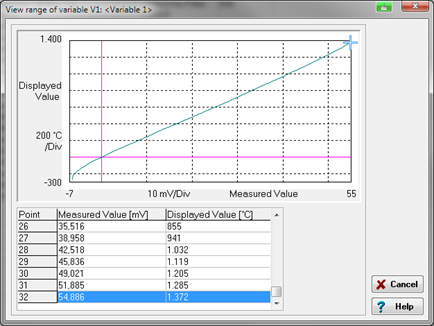
Best-Fit Linearisation Curve for a Type K Thermocouple (−200 °C to +1,372 °C)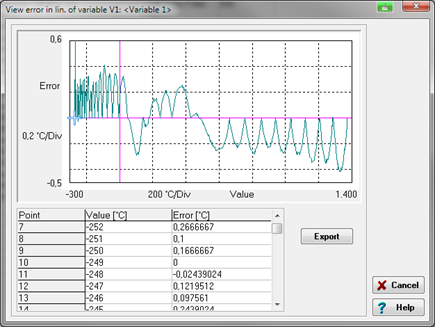
Linearisation Error for a Type K Thermocouple (−200 °C to +1,372 °C)
Example 2: Type K Linearisation for an Application-Specific Range
In practical applications, the thermocouple measurement range can be configured to match the required operating conditions, for example, −50 °C to +500 °C. Optimising the linearisation characteristic for this narrower temperature range reduces the maximum linearisation error to approximately ±0.03 °C.
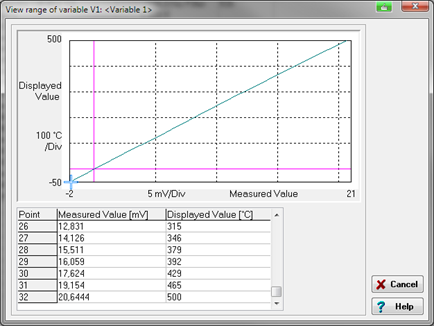
Best-Fit Linearisation Curve for a Type K Thermocouple (−50 °C to +500 °C)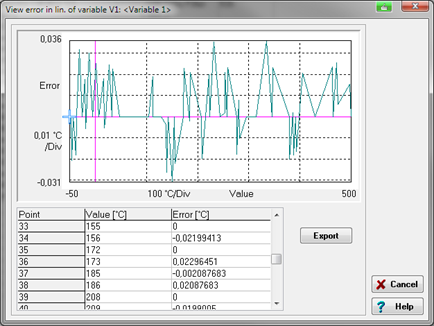
Linearisation Error for a Type K Thermocouple (−50 °C to +500 °C)
DAQ Amplifier Accuracy, Offset and Gain Drift
The Q.series A104 has a maximum amplifier error of 10 µV. For a Type K thermocouple with an average sensitivity of approximately 41 µV/°C, this corresponds to a temperature measurement error of approximately 0.25 °C.
Changes in ambient temperature also affect amplifier performance. The specified temperature coefficients are:
-
Offset drift: less than 1 µV per 10 °C change in ambient temperature, corresponding to less than 0.02 °C / 10 °C for a Type K thermocouple.
-
Gain drift: less than 0.005% per 10 °C change in ambient temperature, corresponding to a maximum error of approximately 0.1 °C / 10 °C at full scale for a Type K thermocouple.
How to Calculate Thermocouple DAQ Measurement Uncertainty: Type K Example
Excluding errors attributable to the thermocouple and extension cable, the measurement uncertainty of the instrumentation can be calculated from the remaining error contributions. The following example assumes a Type K thermocouple configured for a measurement range of −50 °C to +500 °C and a Q.series X A104 module operating at a stable ambient temperature:

For a +20 °C change in ambient temperature, the additional measurement error due to amplifier offset and gain drift is calculated as follows: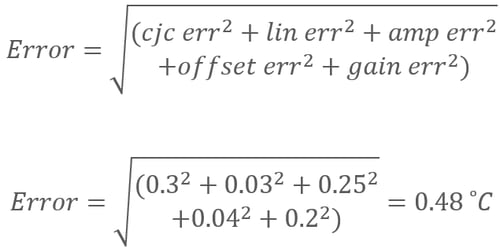
Thermocouple Types, Temperature Ranges and Typical Accuracy
|
Thermocouple |
Overall range |
Typical accuracy* |
Comment |
|
Type B |
100 °C to 1820 °C |
5 °C |
Type B thermocouples are intended for high-temperature measurement. Their thermoelectric output is approximately identical at 0 °C and 42 °C, while sensitivity is very low in this region, making reliable temperature measurement below approximately 50 °C impractical. |
|
Type E |
-270 °C to 1000 °C |
1.7 °C |
Type E thermocouples provide a high sensitivity of approximately 68 µV/°C, enabling accurate measurement of small temperature changes and reliable cryogenic performance. Their non-magnetic construction also makes them suitable for applications sensitive to magnetic interference. |
|
Type J |
-100 °C to 1000 °C |
2.2 °C |
Type J thermocouples have a narrower operating range than Type K and are therefore less widely used. Operation above approximately 760 °C should be avoided, as changes in the iron conductor’s magnetic and metallurgical properties can cause irreversible drift and permanent calibration errors. |
|
Type K |
-270 °C to 1372 °C |
2.2 °C |
Type K is the most widely used general-purpose thermocouple, offering low cost, broad availability and a sensitivity of approximately 41 µV/°C. Its wide temperature range makes it the preferred choice unless application-specific conditions require another thermocouple type. |
|
Type N |
-270 °C to 1300 °C |
2.2 °C |
Type N thermocouples provide high stability and excellent resistance to high-temperature oxidation. Developed as an improved alternative to Type K, they support demanding high-temperature measurements without the cost of platinum-based Types B, R and S. Their use continues to increase. |
|
Type R |
-50 °C to 1760 °C |
1.5 °C |
These thermocouples support high-temperature measurements up to approximately 1,600 °C. However, their low sensitivity of around 10 µV/°C and relatively high cost make them impractical for most general-purpose temperature measurement applications. |
|
Type S |
-50 °C to 1768 °C |
1.5 °C |
Type S thermocouples measure temperatures up to approximately 1,600 °C. Their low sensitivity and high cost limit general-purpose use, but excellent stability makes them suitable as calibration references, including at the gold freezing point of approximately 1,064.18 °C. |
|
Type T |
-270 °C to 400 °C |
1 °C |
Type T offers the highest accuracy among commonly used thermocouples. Its excellent stability and reliable performance at low temperatures make it particularly suitable for food monitoring, refrigeration, laboratory and environmental measurement applications. |
* Accuracy at 0 °C unless indicated. Many manufacturers offer special thermocouples with improved accuracy, reaching as low as 0.5 °C.
Frequently Asked Questions About Thermocouple Accuracy
What are the main sources of thermocouple measurement uncertainty?
Thermocouple measurement uncertainty can result from the thermocouple itself, extension wires, cold junction compensation (CJC), sensor linearisation, DAQ amplifier accuracy, and temperature-dependent offset and gain drift. The total uncertainty depends on the sensor, measurement range, wiring, instrumentation and ambient conditions.
How does cold junction compensation affect thermocouple accuracy?
Cold junction compensation measures the temperature where the thermocouple connects to the measurement instrument and compensates for the resulting thermoelectric voltage. CJC accuracy therefore contributes directly to overall temperature uncertainty. The Q.series X A104 specifies a CJC error below 0.3 °C.
How can I improve thermocouple measurement accuracy?
Use the correct thermocouple and extension wire, minimise unnecessary cable length, maintain good connections, select a measurement range appropriate to the application, and use accurate cold junction compensation and low-drift DAQ hardware. Restricting the configured temperature range can also reduce linearisation error.
How does DAQ amplifier accuracy affect thermocouple measurements?
A thermocouple generates only microvolts per degree, so small DAQ amplifier errors can create measurable temperature errors. For example, the Q.series A104 has a maximum amplifier error of 10 µV, corresponding to approximately 0.25 °C for a Type K thermocouple at 41 µV/K.
Which thermocouple type provides the best accuracy?
There is no universally most accurate thermocouple; selection depends on temperature range, environment and application. Among the common types compared in this guide, Type T has a typical accuracy of approximately 1 °C and is suitable for temperatures from about −270 °C to 400 °C.
Thermocouple Measurement Standards and Technical References
-
IEC 60584-1 — Thermocouples: EMF Specifications and Tolerances
The key international standard for thermocouple reference functions, EMF characteristics and tolerance classes for common thermocouple types.
IEC 60584-1 – Thermocouples -
NIST Monograph 175 — Thermocouple Reference Functions and Tables
Authoritative ITS-90 temperature-to-EMF reference functions and tables for Types B, E, J, K, N, R, S and T thermocouples. Excellent supporting authority for thermocouple linearisation and sensitivity.
NIST Thermocouple Reference Functions and Tables -
JCGM 100:2008 — Guide to the Expression of Uncertainty in Measurement (GUM)
The fundamental international reference for evaluating, combining and expressing measurement uncertainty. This is especially valuable for strengthening the article's treatment of overall thermocouple measurement uncertainty.
BIPM – Guide to the Expression of Uncertainty in Measurement -
Gantner Instruments — Sensors Explained
Practical engineering guidance covering sensor measurement principles, including thermocouples, temperature measurement and cold-junction compensation with Gantner DAQ systems.
Gantner Instruments – Sensors Explained -
Gantner Instruments — Q.series X DAQ System
Technical information on the Q.series X measurement platform used for high-accuracy temperature and mixed-signal data acquisition, providing product context for the Q.series X A104 discussed in the article.
Gantner Instruments – Q.series X DAQ System