![favicon_GI.png]](https://knowledge.gantner-instruments.com/hs-fs/hubfs/favicon_GI.png?width=40&height=40&name=favicon_GI.png)
A thermocouple can measure temperature directly on an electrically live or high-voltage component when the DAQ input supports the required common-mode voltage and galvanic isolation. The differential input measures the thermocouple’s small temperature-dependent voltage while rejecting the larger common-mode voltage present on both thermocouple conductors.
How Does a Thermocouple Measure Temperature?
A thermocouple measures temperature using the Seebeck effect. Two dissimilar conductors generate a small differential voltage related to the temperature difference between the measuring and reference junctions. Because this signal is typically only microvolts to millivolts, the measurement system requires accurate differential inputs and cold-junction compensation (CJC) to determine temperature.
When measuring electrically live components, the DAQ system must also handle the electrical potential on which this small thermocouple signal is superimposed.
What Happens When a Thermocouple Is Connected to an Electrically Live Component?
An electrically uninsulated thermocouple can be mounted directly on an electrically live component if the measurement system provides suitable common-mode capability and galvanic isolation.
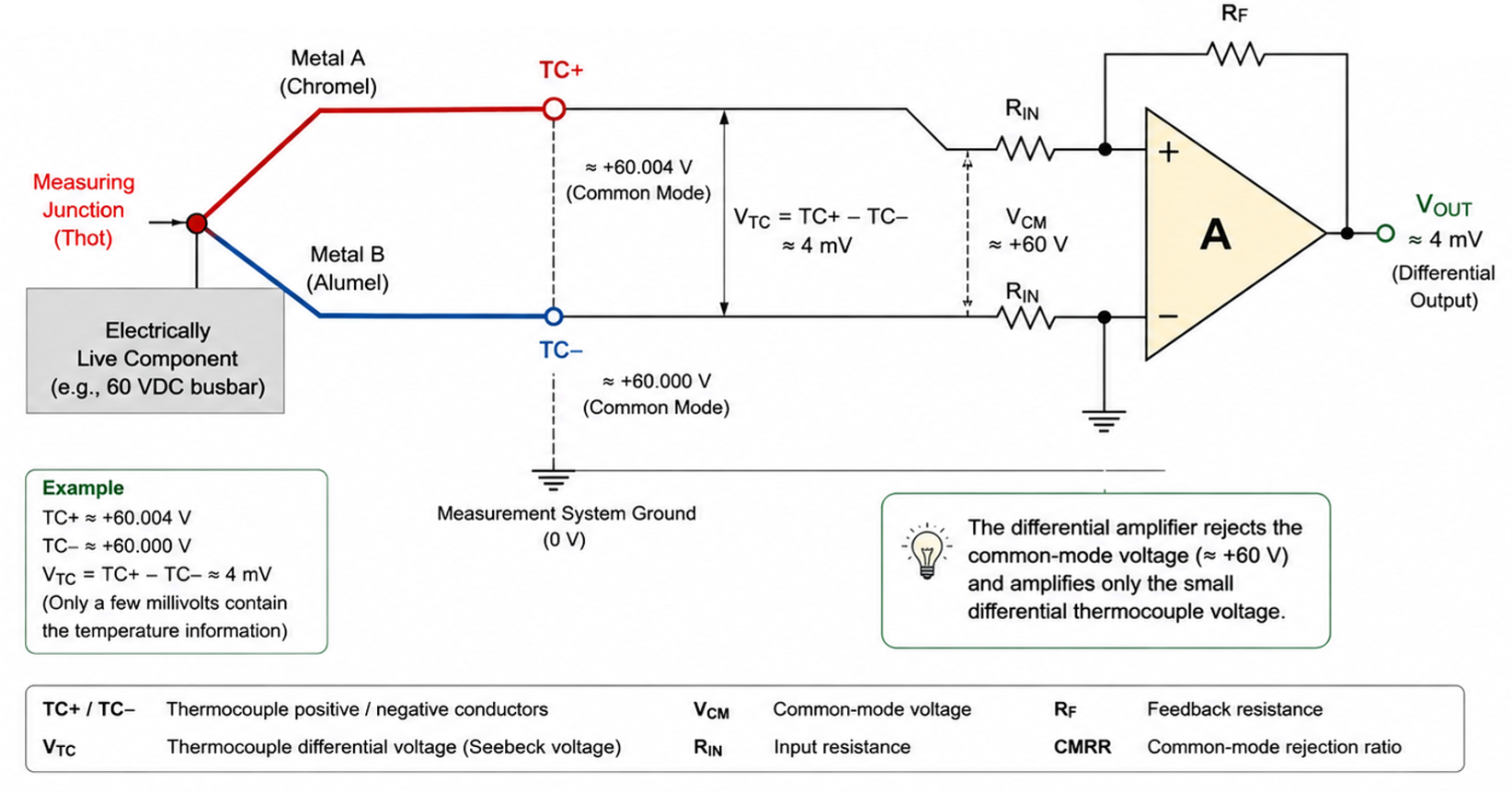
For example, with a thermocouple mounted on a 60 VDC busbar, both thermocouple conductors float at approximately 60 V relative to measurement-system ground. The temperature-dependent thermocouple signal (typically only a few millivolts) is superimposed on this much larger common-mode voltage.
Common-Mode Voltage vs. Differential Thermocouple Voltage
A differential input measures the voltage difference between the thermocouple conductors:
Vmeasured = VTC+ − VTC−
For example:
VTC+ = 60.004 V
VTC− = 60.000 V
Vmeasured = 4 mV
Because the 60 V common-mode component is present on both conductors, the differential input rejects it and measures the small thermocouple signal.
However, common-mode rejection is not the same as electrical isolation. The input must still be rated to withstand the electrical potential between the thermocouple, other channels, power supply, and communication interface.
Does Current from the Live Component Flow Through the Thermocouple?
No. If the 60 VDC busbar carries 300 A, that load current continues through the busbar and its connected load. The thermocouple is not part of this current path.
Only very small input, bias, or leakage currents can occur in the measurement circuit. A high input impedance minimizes sensor loading. Therefore, the busbar's current rating does not determine the thermocouple input requirement; the voltage potential, isolation, transient conditions, and fault energy are the critical considerations.
Why Is Galvanic Isolation Required for Thermocouple Measurements on Live Components?
Galvanic isolation prevents unwanted conductive paths between electrically live measuring points and the rest of the DAQ system. Depending on the application, sufficient permanent isolation is required between:
- Measurement channels and communication interface
- Measurement channels and power supply
- Individual channels operating at different electrical potentials
Channel-to-channel isolation is particularly important when multiple thermocouples are connected to components at different voltages.
Measuring Thermocouples at High Voltage with the Q.series X A124 Plus
The Gantner Instruments Q.series X A124 PLUS TCK is a 4-channel, galvanically isolated thermocouple measurement module designed for temperature measurements where sensors may be at different or high electrical potentials.
| Specification | Q.series X A124 PLUS TCK |
|---|---|
| Thermocouple inputs | 4 channels, Type K |
| ADC resolution | 24 bit |
| Sampling rate | Up to 20 kHz per channel |
| Cold-junction compensation | Integrated |
| Galvanic isolation | Channel-to-channel, power supply, and interface |
| Permanent isolation | Up to 1500 VDC |
| Measurement category | 1000 V CAT II / 600 V CAT III |
The combination of differential thermocouple measurement and galvanic isolation enables accurate temperature acquisition on electrically live components while maintaining electrical separation between measurement channels and the DAQ system.
When selecting a measurement system, always verify the continuous working voltage, transient overvoltages, channel-to-channel potential, sensor and cable insulation, connectors, fault energy, and applicable electrical-safety requirements.
Learn more about Gantner Instruments high-voltage measurement solutions.
Frequently Asked Questions About Thermocouple Measurements on Live Components
Can a thermocouple be attached directly to an electrically live component?
Yes, provided the thermocouple and measurement system are suitable for the application. An exposed or grounded thermocouple junction can be electrically connected to a live component when the measurement module supports the resulting common-mode voltage and provides sufficient galvanic isolation. The thermocouple leads, connectors, wiring, and mounting method must also be appropriately insulated and protected.
What happens to a thermocouple when it is connected to a live busbar?
Both thermocouple conductors float at approximately the electrical potential of the busbar. The much smaller thermocouple voltage generated by the temperature difference is superimposed on this common-mode voltage. A suitable differential measurement input measures the voltage difference between the thermocouple conductors while rejecting the common-mode component.
Does the current flowing through a busbar also flow through the thermocouple?
No. A thermocouple attached to a busbar is not part of the busbar's load-current path. Only a very small input or leakage current can flow through the measurement input because the DAQ module has a high input impedance. The module's voltage, isolation, transient, and fault-energy ratings must still be suitable for the application.
Why is galvanic isolation important when measuring thermocouples on live components?
Galvanic isolation electrically separates the measurement channel from other parts of the DAQ system and helps prevent unwanted current paths between circuits at different potentials. Depending on the application, sufficient isolation may be required between channels, between measurement channels and the power supply, and between measurement channels and the communication interface.