![favicon_GI.png]](https://knowledge.gantner-instruments.com/hs-fs/hubfs/favicon_GI.png?width=40&height=40&name=favicon_GI.png)
Measurement accuracy in a DAQ system defines how closely a measured value represents the true value. For Gantner Instruments Q.series modules, datasheet accuracy is specified as a percentage of full scale (%FS). Calculating the resulting measurement error requires applying this percentage to the selected input range and accounting for relevant environmental and temperature effects.
What Is Measurement Accuracy?
Measurement accuracy refers to the degree of closeness between a measured value and the true value of the quantity being measured. In other words, it is a measure of how well a measurement reflects the actual or real value of the quantity. High measurement accuracy indicates that the measured values are very close to the true values, while low accuracy implies a greater divergence between the measured and true values.
Accuracy is a critical aspect in various fields such as science, engineering, manufacturing, and research, where precise and reliable measurements are essential. It is often expressed as a percentage or in terms of a specific unit of measurement. Calibration, regular maintenance, and adherence to standardized measurement procedures are important for ensuring and improving measurement accuracy.
Accuracy, Precision, Resolution, and Measurement Uncertainty
Accuracy, precision, resolution, and measurement uncertainty describe different aspects of measurement system performance and should not be used interchangeably. Accuracy indicates how close a measured value is to the true or reference value, while precision describes the consistency of repeated measurements. Resolution is the smallest change in the input signal that a data acquisition system can distinguish, and measurement uncertainty quantifies the doubt associated with a measurement result. Understanding these differences is essential when selecting a DAQ system and evaluating whether its measurement performance is suitable for a specific test or monitoring application.
Accuracy, Precision, Resolution, and Measurement Uncertainty
Accuracy, precision, resolution, and measurement uncertainty describe different aspects of measurement system performance and should not be used interchangeably. Accuracy indicates how close a measured value is to the true or reference value, while precision describes the consistency of repeated measurements. Resolution is the smallest change in the input signal that a data acquisition system can distinguish, and measurement uncertainty quantifies the doubt associated with a measurement result. Understanding these differences is essential when selecting a DAQ system and evaluating whether its measurement performance is suitable for a specific test or monitoring application.
| Term | What it describes | Practical meaning |
|---|---|---|
| Accuracy | Closeness of a measurement to a true or reference value | How correct is the measured value? |
| Precision | Agreement between repeated measurements | How repeatable are the measurements? |
| Resolution | Smallest detectable change in the measured signal | How small a change can the DAQ system distinguish? |
| Measurement uncertainty | Quantified doubt associated with a measurement result | What range of values can reasonably be attributed to the measured quantity? |
How Is DAQ Module Measurement Accuracy Specified?
Measurement Accuracy as a Percentage of Full Scale (%FS)
The accuracy specification on the datasheet for Q.series measurement modules is determined based on the % full scale (%FS) of the module channel's measurement range.
Measurement Accuracy Under Different Environmental Conditions
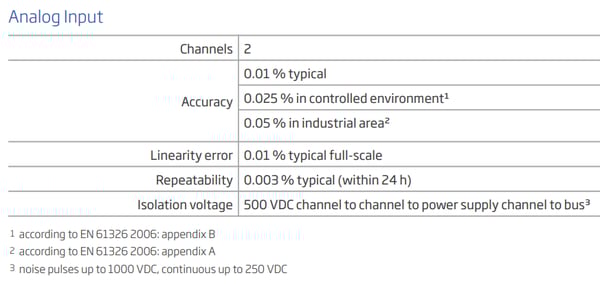
Furthermore, the accuracy is influenced by the environmental conditions where the data acquisition hardware is situated. In a typical environment, the accuracy is 0.01%; in a controlled environment, it is 0.025%; and in an industrial area, it is 0.05%.
How to Calculate Measurement Accuracy: Load Cell Example
The measurement accuracy for a ±2 mV/V load cell with a ±50'000 N range, 10 V excitation, and ±2.5 mV/V input range is calculated as follows:- Error in mV/V = ±2.5 mV/V * 0.05% (for an industrial environment) = ±0.00125 mV/V
- Since 2 mV/V corresponds to ±50'000 kN, 1 mV/V is equivalent to ±25'000 kN
- Error in engineering units = ±0.00125 mV/V * ±25'000 N = ±31.25 N
What Errors Are Included in the Measurement Accuracy Specification?
Temperature Effects: Zero Drift and Gain Drift
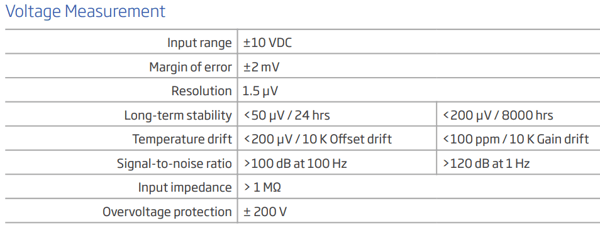
The zero offset and gain offset are integral components of our calibration standards when determining accuracy specifications. For analog input modules, these specifications account for the temperature effects of both zero offset and gain drift, with units expressed per 10 degrees Kelvin, presented as separate line items.
Datasheet example:
.
Input Noise and Measurement Uncertainty
When addressing input noise errors, we incorporate them into the specifications using a standard confidence factor following the Guide to the Expression of Uncertainty in Measurement (GUM). GUM is a widely recognized and internationally accepted document published by the Joint Committee for Guides in Metrology (JCGM). These errors are determined according to EN 61326-1:2006, considering the noise suppression electronics.
The calculations cover channel-to-channel, channel-to-ground, and channel-to-bus voltage isolations, set at 500 VDC for standard Q.series and Q.series X modules, and 1200 or 1500 VDC for the higher isolation A12x modules. Testing and specifications involve noise pulses up to 1000 VDC, with continuous testing up to 250 VDC. Any noise error exceeding these levels is not included in the accuracy specifications due to challenges in determination.
Datasheet example:
Frequently Asked Questions About DAQ Measurement Accuracy
How is DAQ measurement accuracy calculated from percentage of full scale?
Multiply the full-scale measurement range by the specified accuracy percentage. For example, an accuracy specification of ±0.05% FS on a ±2.5 mV/V range corresponds to an input error of ±0.00125 mV/V.
What does %FS mean in a DAQ accuracy specification?
%FS means percentage of full scale. It means the specified error is calculated relative to the full measurement range rather than the instantaneous measured value.
Does temperature affect DAQ measurement accuracy?
Yes. Changes in ambient temperature can introduce zero offset drift and gain drift. Gantner Instruments analog input module datasheets specify these temperature effects separately, typically relative to a temperature change.
What errors are included in Gantner Instruments measurement accuracy specifications?
The specifications account for factors including zero offset, gain offset, temperature effects, and input noise. The article also describes EMC and isolation conditions used when evaluating measurement performance.
What is the difference between measurement accuracy and measurement uncertainty?
Accuracy describes how closely a measured value agrees with the true quantity value. Measurement uncertainty quantifies the uncertainty associated with a measurement result and provides a range within which the value can reasonably be expected.