![favicon_GI.png]](https://knowledge.gantner-instruments.com/hs-fs/hubfs/favicon_GI.png?width=40&height=40&name=favicon_GI.png)
This article highlights several options for input-to-output communication and the corresponding latency. The options are listed from fastest to slowest.
1. Module-internal communication
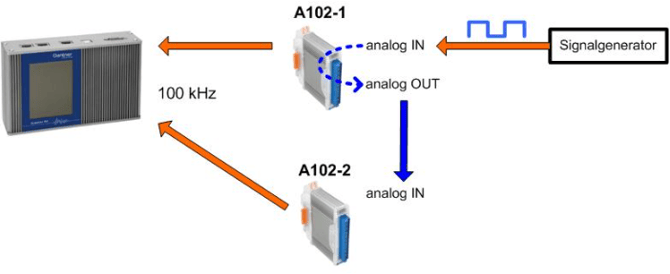
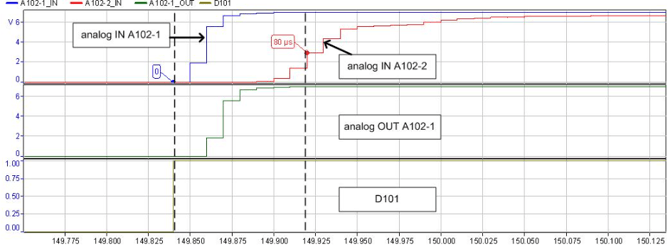
Module-internal communication typically takes one measurement cycle of the module. The A102 was used because the SAR has very low signal propagation delays. Digital communication is identical across all modules.
2. Inter-module communication
Inter-module communication uses the UART interface and depends on the UART sample frequency. It requires at least one additional sample cycle for data transfer between modules.
3. Communication via controller
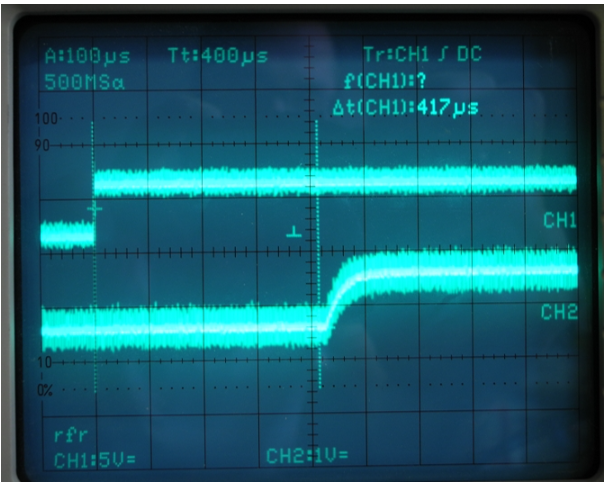
Via the controller, at a 10 kHz sample rate, the typical input-to-output latency is approximately 400 µs. Signal propagation delays of the modules must be added to this value.
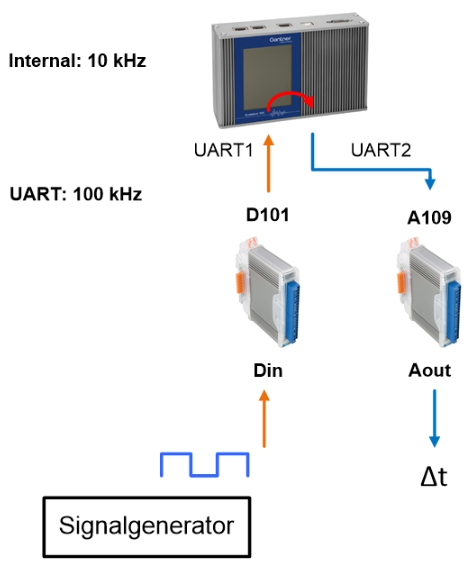
Result: (Ch1 = Din1; Ch2 = Aout)
4. Communication via an EtherCAT master
Using an EtherCAT master at 10 kHz via a controller results in a minimum latency of approximately 900 µs.
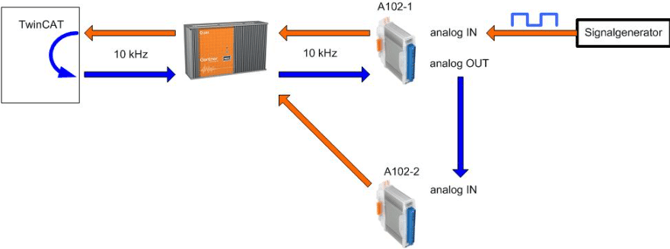
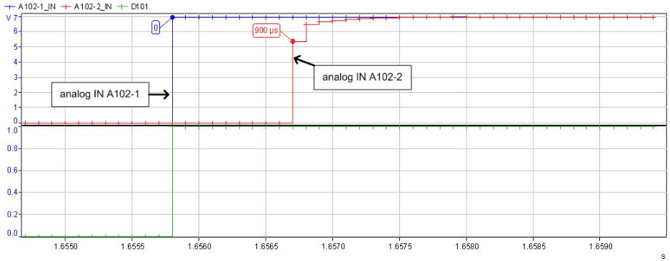
5. Communication via an EtherCAT bus coupler
Using an EtherCAT master at 10 kHz via a Q.series XE bus coupler results in a latency of approximately 1 ms.