![favicon_GI.png]](https://knowledge.gantner-instruments.com/hs-fs/hubfs/favicon_GI.png?width=40&height=40&name=favicon_GI.png)
What is a loop-powered sensor?
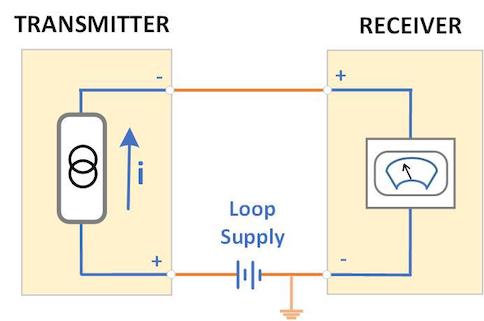
Loop powered sensors are field sensors that are powered directly from the same electrical current loop that carries their measurement signal, most commonly a 4-20 mA current loop.
The loop typically consists of a single transmitter (sensor), a receiver, and a power supply connected in series. In the example below, the transmitter is the sensor, and the receiver is the Gantner Instruments module. Electrical power and the analogue measurement signal are both transferred over the same pair of wires.
How to connect a loop-powered sensor?
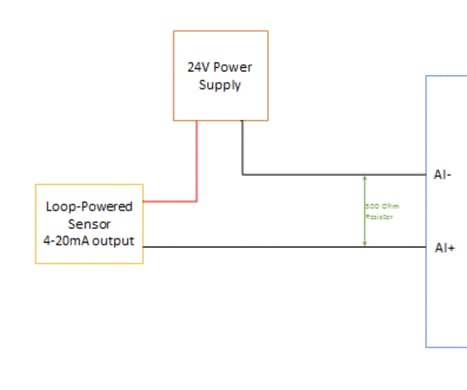
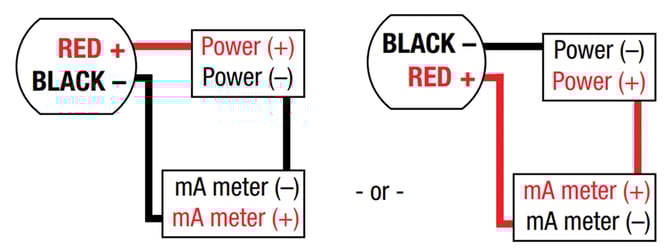
There are two methods to connect a loop-powered device to a Gantner Instruments module. In both cases, the power supply is connected in series within the loop between the sensor transmitter and the receiver module.
Method 1
-
Negative from the power supply → AI- of channel on module
-
Negative of the sensor → AI+ of channel on module
Method 2
-
Positive from the power supply → AI+ of channel on module
-
Positive from the sensor → AI- of channel on module
Example of connection to the module
e.g. A108 with shunt resistor terminal block: