![favicon_GI.png]](https://knowledge.gantner-instruments.com/hs-fs/hubfs/favicon_GI.png?width=40&height=40&name=favicon_GI.png)
The HBK T40B digital torque transducer can be measured with a Gantner D107 using its 30–90 kHz frequency output. Configure the D107 for differential frequency measurement and use the Cronos method to calculate frequency from detected signal edges. With a 70 µs measurement base and appropriate oversampling, a new measurement result can be generated every 100 µs.
HBK T40B Frequency Output Specifications
-
30 - 90 kHz frequency output
-
33.3 - 11.1 µs periods
From T40B Torque Measurement to Acquired Data
The measurement chain converts the mechanical torque measured by the HBK T40B digital torque transducer into data that can be acquired and processed by the Gantner measurement system.
The T40B provides a frequency output of 30–90 kHz, with the output frequency representing the measured torque. This signal is connected to the differential input of the Gantner D107, where rising signal edges are detected for high-speed frequency measurement.
Using the Cronos measurement method, the D107 evaluates the signal within a defined measurement interval (Tbase). NrOfSamples represents the signal periods detected during this interval, while T_measured is the measured elapsed time associated with those periods. The input frequency is calculated as:
f = NrOfSamples / T_measured
The resulting frequency is then converted to the corresponding torque engineering value using the transducer’s defined frequency-to-torque relationship.
For this application, Tbase is set to 70 µs. Oversampling allows the D107 to evaluate the input signal at a higher internal rate than the required output data rate. The configured measurement chain produces a new acquired torque measurement every 100 µs, equivalent to a 10 kHz output data rate.
HBK T40B to Gantner D107 Wiring and Sensor Connections
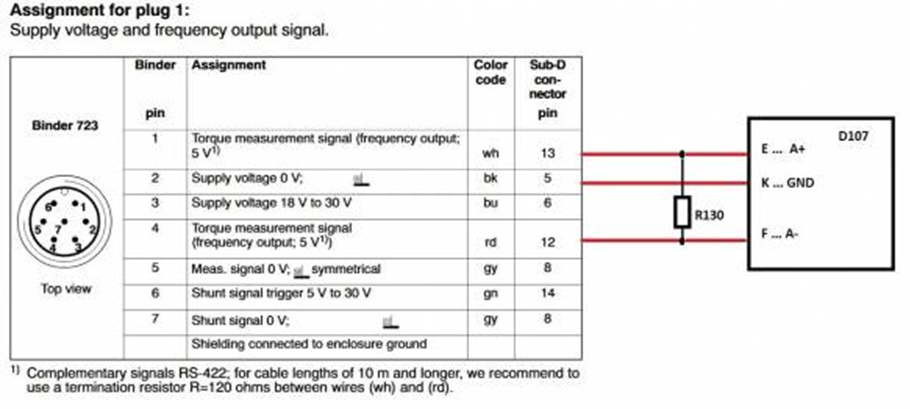
Configure the Gantner D107 for T40B Frequency Measurement
For high-speed torque measurement with the HBK T40B, configure the Gantner D107 to measure the transducer’s frequency output using a differential input. The following settings provide a new calculated measurement value every 100 µs, corresponding to a 10 kHz sample rate.
| Parameter | Recommended Setting |
|---|---|
| Sensor / transducer | HBK T40B torque transducer |
| D107 input type | Frequency measurement |
| Input connection | Differential |
| T40B frequency output | 30–90 kHz |
| Measurement method | Cronos |
| Tbase | 70 µs |
| Sample rate | 10 kHz |
| Oversampling | 10 samples |
| Measurement time | 80 µs |
| Output interval | 100 µs |
With these settings, the D107 measures the T40B frequency signal within the available 100 µs sampling interval. The measured frequency can then be scaled to the corresponding torque value using the transducer’s frequency-to-torque relationship.
Frequently Asked Questions About HBK T40B Torque Measurement
What frequency output does the HBK T40B torque transducer provide?
The HBK T40B configuration described here provides a frequency output from 30 to 90 kHz, corresponding to signal periods of approximately 33.3 to 11.1 µs.
How do you measure an HBK T40B with a Gantner D107?
Configure the D107 input for differential frequency measurement. The Cronos measurement method counts rising edges during a defined measurement interval and calculates the frequency using the number of detected edges and measured elapsed time.
How is frequency calculated using the Cronos measurement method?
The frequency is calculated from the number of detected rising edges (NrOfSamples) divided by the measured time (T_measured) between the first and last detected edges: f = NrOfSamples / T_measured.
What D107 settings are used for 100 µs measurement results?
The example uses frequency mode, a differential input, Tbase = 70E-6, and oversampling configured at 10 kHz with 10 samples. The objective is to obtain a new result every 100 µs.
Why use frequency measurement for the HBK T40B?
The T40B configuration covered by this application example supplies torque information through a 30–90 kHz frequency output. The D107 measures this signal frequency, allowing the sensor output to be incorporated into the Gantner measurement system.