![favicon_GI.png]](https://knowledge.gantner-instruments.com/hs-fs/hubfs/favicon_GI.png?width=40&height=40&name=favicon_GI.png)
The Chronos method measures frequency by combining pulse counting with precise edge-to-edge timing. Gantner Instruments Q.series X A109, D101, and D107 digital input modules use 20.8 ns timing resolution to measure frequencies up to 1 MHz, while automatic interval extension enables measurements down to 0.5 Hz.
How Does the Chronos Method Measure Frequency?
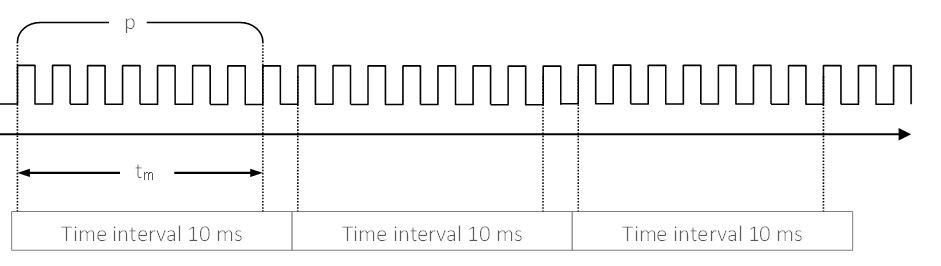
The Chronos method allows for accurate frequency measurement of both low and high frequencies. This method combines the advantages of time measurement and pulse counting, where the pulses within a specific time interval are counted. To achieve the highest accuracy, we use not the pre-set time interval, but rather the time between the first and the last positive edge to calculate the frequency.
With a standard clock frequency of 48 MHz, one count represents 20.8 ns. This resolution allows us to detect the frequency independently of the input frequency itself. The selectable time interval ranges from 0.001 s to 10 s, and the maximum input frequency is 1 MHz.
For instance, with an input frequency of 715.238 Hz, there will be 8 positive edges, or 7 periods, within a single time interval of 10 ms. The time elapsed from the first to the last positive edge is precisely 9.78695 ms (with a resolution of 20.8 ns). The calculated frequency is then determined as 7 / 9.78695 ms x 1000 = 715.238 Hz.
The Chronos method offers several advantages:
- It requires only one pulse for precise frequency measurement.
- It has an integrating character, reducing measurement signal noise.
- Measured values are divided into fixed time intervals.
- The time interval is user-selectable.
- The method is applicable for continuous measurement from 1 Hz to 1 MHz.
For very low frequencies where no edges are detected within a selected time interval (e.g., 100 ms), the method automatically extends the interval until the next pulse occurs, allowing measurement even for very low frequencies. The edge-to-edge time is measured with a resolution of 20.8 ns, applicable to input frequencies down to 0.5 Hz.
If the frequency suddenly stops, the measured value gradually ramps down to zero within 2 seconds using an exponential function, eliminating abrupt jumps.
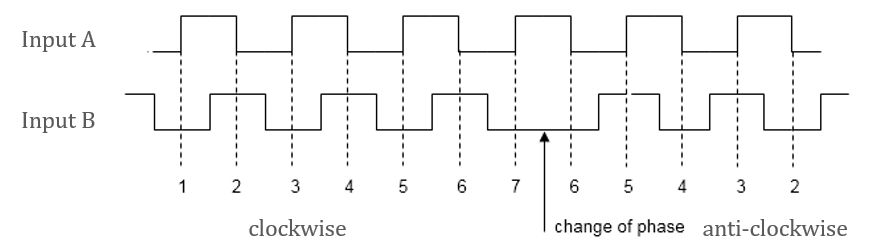
The quadrature function requires a sensor that provides two signals with a 90° phase shift. This method has the advantage of not detecting external disturbances like torsional vibrations as a frequency. Additionally, the phase shift can be used to determine the direction of rotation.
Chronos Method vs. Conventional Frequency Measurement
Conventional frequency measurement counts pulses within a fixed time interval and calculates frequency from the pulse count. This works well at higher frequencies but can reduce resolution at low frequencies when only a few pulses occur within the measurement window.
The Chronos method combines pulse counting with precise edge-to-edge timing. It calculates frequency using the number of complete periods and the actual elapsed time between detected signal edges, improving measurement resolution across a wide frequency range.
| Characteristic | Conventional method | Chronos method |
|---|---|---|
| Measurement principle | Counts pulses in a fixed interval | Counts periods and precisely times signal edges |
| Low-frequency measurement | Limited when few pulses occur | Measurement interval can automatically extend |
| Timing | Fixed measurement window | Actual edge-to-edge time |
| Key advantage | Simple measurement at higher frequencies | High-resolution measurement across a wide frequency range |
With compatible Gantner Instruments Q.series X modules, the Chronos method supports frequency measurement from 0.5 Hz to 1 MHz with 20.8 ns edge-timing resolution, making it suitable for pulse signals, RPM, encoders, flow meters, and tachometers.
Which Q.series X DAQ Modules Support Frequency Measurement?
In addition to state, PWM, and counter measurements, the Q.series A109, D101, and D107 digital input modules offer three types of frequency measurement:
- Standard single-ended, 4-channel frequency input.
- Standard 2-wire, 4-channel frequency input, including direction.
- Quadrature 2-wire, 4-channel frequency input or 2-channel signal A and B
with 90° phase shift.
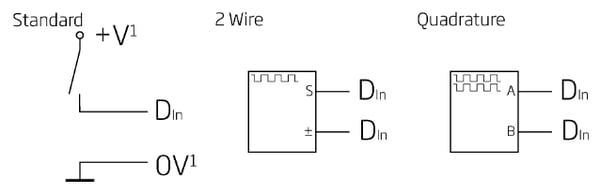
Quadrature inputs are available on A109 and D101 modules only.
How to Configure Frequency Inputs for TTL, HTL, and Differential Signals
To adjust the input stages to the sensor, you can choose from two selectable input levels:
-
TTL (logic 0 (LOW) <0.8 VDC / logic 1 (HIGH) >2.0 VDC)
-
HTL acc. EN61131-2 (logic 0 (LOW) -3 to +5 VDC / logic 1 (HIGH) +10 to +30 VDC)
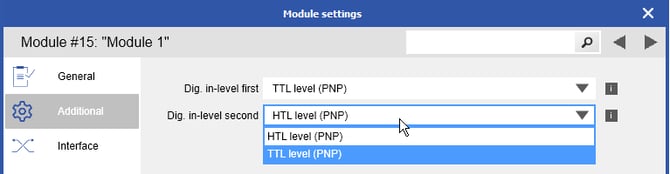
The D107 module features user-configurable thresholds, ranging from 0 to +26 VDC for single-ended inputs and -20 to +20 VDC for differential inputs.
To obtain the measurement value in calibrated engineering units, the software provides a scaling function: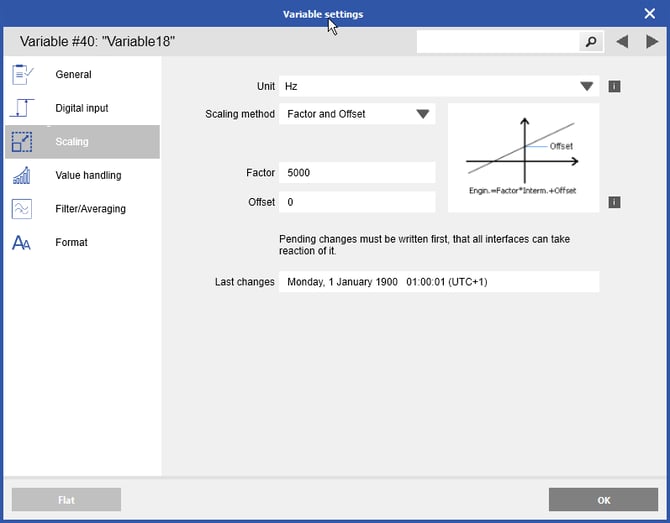
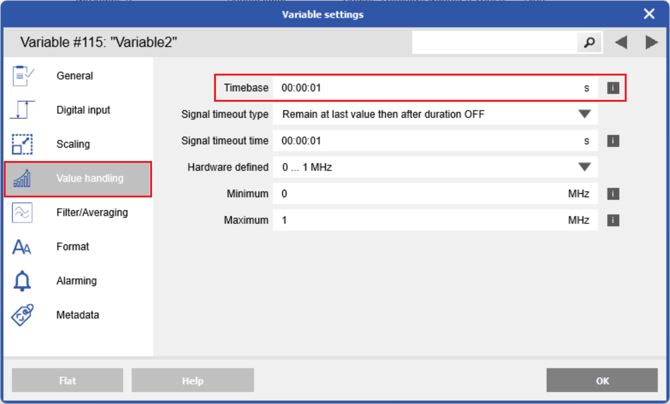
The time interval setting can be found in the Value handling section of the digital input variable. Change the timebase setting by typing in the value for the interval.
How to Choose the Frequency Measurement Timebase
The measurement timebase determines how quickly the measured frequency responds to signal changes. A shorter timebase provides faster updates and is well suited to high-frequency or rapidly changing signals. A longer timebase captures more signal periods and is generally better for low-frequency or slowly changing signals.
| Input frequency | Suggested starting timebase | Typical use |
|---|---|---|
| 1–10 Hz | 1 s | Slow processes and low-speed rotation |
| 10–100 Hz | 100 ms–1 s | Low-frequency pulse signals |
| 100 Hz–10 kHz | 10–100 ms | General frequency and speed measurement |
| Above 10 kHz | 1–10 ms | Fast-changing, high-frequency signals |
These values are practical starting points rather than fixed requirements. Select the timebase according to the lowest expected frequency, required response time, and dynamics of the application.
If insufficient signal edges occur within the selected interval, the Chronos method automatically extends the measurement interval until another pulse is detected. This enables reliable measurement even when the input frequency falls below the range expected for the configured timebase.
Frequently Asked Questions About Frequency Measurement
What is the Chronos method for frequency measurement?
The Chronos method combines pulse counting with precise time measurement. Instead of calculating frequency from only a predefined measurement interval, it measures the elapsed time between the first and last detected positive edges and uses the number of periods between them to calculate frequency accurately.
What frequency range can Q.series modules measure using the Chronos method?
The Chronos method supports continuous frequency measurement from 1 Hz to 1 MHz. For very low-frequency signals, the measurement interval automatically extends until another pulse is detected, enabling edge-to-edge measurements down to 0.5 Hz.
Which Gantner Instruments modules support Chronos frequency measurement?
The A109, D101, and D107 digital input modules support frequency measurement. Available modes include standard single-ended and 2-wire frequency measurement, while quadrature inputs are available on the A109 and D101 modules.
Can the Chronos method measure quadrature encoder signals and rotation direction?
Yes. With the A109 or D101, two encoder signals shifted by 90° can be measured in quadrature mode. The phase relationship enables determination of rotation direction and helps prevent disturbances such as torsional vibration from being incorrectly interpreted as frequency.
What input signal levels can be used for frequency measurement?
Q.series frequency inputs support TTL and HTL signal levels. The D107 additionally provides configurable thresholds from 0 to +26 VDC for single-ended inputs and -20 to +20 VDC for differential inputs, allowing the input stage to be adapted to different sensors.