![favicon_GI.png]](https://knowledge.gantner-instruments.com/hs-fs/hubfs/favicon_GI.png?width=40&height=40&name=favicon_GI.png)
EN 50160 describes voltage characteristics at a user’s supply terminals on public electricity networks. IEC 61000-4-30 specifies how power quality parameters are measured in 50 Hz and 60 Hz systems. For a defensible assessment, identify the correct measurement point, specify the applicable editions and measurement class, and verify the complete measurement chain before interpreting results.
What voltage characteristics does EN 50160 cover?
EN 50160 specifies the main characteristics of voltage at a network user’s supply terminals under normal operating conditions. It applies to public low, medium, high and extra-high voltage alternating current networks. Characteristics include supply frequency, voltage magnitude, fluctuations, unbalance and waveform distortion. Industrial networks fall outside its scope.
The measurement location is therefore essential. A reading taken at an inverter output or within a facility may help diagnose a disturbance, but it does not necessarily describe the voltage supplied at the network user’s supply terminals. EN 50160 characteristics are also not emission limits for individual products.
How does IEC 61000-4-30 define power quality measurements?
IEC 61000-4-30 defines methods for measuring and interpreting power quality parameters in 50 Hz and 60 Hz alternating current supply systems. These include voltage magnitude, frequency, harmonics, interharmonics, unbalance, flicker, dips, swells and interruptions. Its Class A and Class S designations specify measurement methods intended to produce reliable, repeatable results.
Displaying a parameter such as harmonics does not establish that an analyser follows an IEC 61000-4-30 measurement class. Formal assessments require confirmation of the methods supported for the relevant instrument and parameters. IEC 62586-2 addresses functional tests and uncertainty requirements for instruments using Class A or Class S methods. Separate standards address specific measurements, including IEC 61000-4-7 for harmonics and interharmonics and IEC 61000-4-15 for flicker.
EN 50160 versus IEC 61000-4-30: key differences
| Aspect | EN 50160 | IEC 61000-4-30 |
|---|---|---|
| Purpose | Describes the voltage characteristics expected from public electricity networks under normal operating conditions. | Specifies methods for measuring and interpreting power quality parameters. |
| Scope | Public low, medium, high and extra-high voltage alternating current networks. It does not cover internal industrial networks. | Conducted power quality phenomena in alternating current supply systems with a declared frequency of 50 Hz or 60 Hz. |
| Measurement location | The network user’s supply terminals are the reference point for assessing supplied voltage. | Defines measurement methods; the assessment objective determines where the instrument is installed. |
| Role in an assessment | Establishes which supplied-voltage characteristics are assessed. | Establishes how the selected parameters are measured so that results are reliable and comparable. |
How to conduct a defensible power quality assessment
- Define the objective. Assessing a public supply, investigating a facility disturbance and analysing a power converter are different tasks. State the question the results must answer.
- Choose the measurement point. For an EN 50160 assessment, identify the relevant network user’s supply terminals. Record any additional measurement points separately.
- Specify the methods in advance. Name the applicable standards editions, required IEC 61000-4-30 class, parameters, assessment period and any contractual or network operator requirements.
- Check the measurement chain. Confirm the analyser’s documented capabilities, configuration, calibration status and the suitability of any external voltage or current transducers. Transducers can influence measurement results. (webstore.iec.ch)
- Preserve the context. Record the time, network configuration and relevant operating or switching events. In the report, identify missing data and distinguish measured results from conclusions about conformity.
These steps make results easier to interpret and compare. They also prevent a useful diagnostic measurement from being mistaken for a formal standards assessment.
Gantner Power Analyzers for diagnostic power analysis
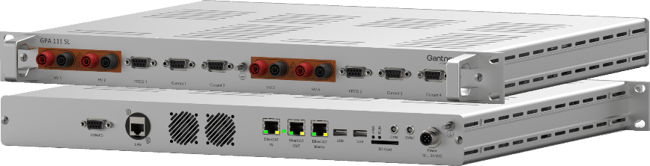
Gantner Power Analyzers measure voltage and current in three-phase systems and analyse parameters including harmonics, interharmonics, voltage fluctuations, unbalance and power factor. They are designed for applications such as inverter and electric drive testing. For an assessment under EN 50160 using IEC 61000-4-30 methods, confirm the required measurement point, parameters, standard edition and measurement class against the specific instrument documentation before selecting an analyser.
Frequently asked questions about EN 50160 and IEC 61000-4-30
What is the difference between EN 50160 and IEC 61000-4-30?
EN 50160 describes voltage characteristics at users’ supply terminals on public electricity networks. IEC 61000-4-30 specifies methods for measuring power quality parameters. The applicable EN 50160 criteria and the measurement method both matter when assessing results.
Where should measurements be taken for an EN 50160 assessment?
Identify the relevant network user’s supply terminals. Measurements elsewhere in a facility can help locate a disturbance, but should be reported separately from an assessment of the supplied voltage.
Does displaying harmonics mean an analyser complies with IEC 61000-4-30?
No. A displayed parameter alone does not establish a measurement class. Check the instrument’s documented methods, supported parameters and applicable edition. IEC 62586-2 provides test methods for verifying IEC 61000-4-30 compliance.
Does EN 50160 apply to measurements inside an industrial facility?
It describes voltage at the network user’s supply terminals on public networks. Internal measurements can support fault diagnosis but should be distinguished from an assessment of supplied voltage at those terminals.